HWBZ40×60/60×100SN
HWBZ40×60/60×100SN
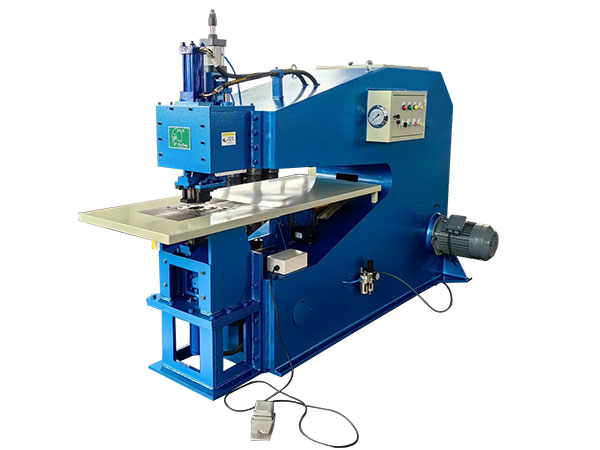
Built-in Strip Feeding Unit Double-headed Automatic Veneer Patching Machine
Index
Brief account 2
Main technical parameters 2
Brief introduction of structure 3
Operating procedure 4
nstallation and adjustment 5
Check and maintenance 6
Attached diagram 7
- Brief
We need to mend nature flaw on the veneer in the process of man-made board,
especially plywood. For a long time, manual mending has been used in most of
plywood production enterprises in our country. Or it needs to hand mending
after the hole and patch are cut with die, and adhere with tape or markinf
line. Thus this process has disadvantages of high material consumption, lots
of labour consume and long time. The visual result is not good and will affect
the appearance.
Our Built-in Strip Feeding Unit Double-headed Automatic Veneer Patching
Machine has pressure dies, middle dies, upper punches and lower punches,so it
can finish mending within a process. It solves the problem of mending holes of
different sizes in a machine, to fill the gaps in the industry. It applies to
mend all kinds of wood veneers, and can auto-feed continuously. Its
characteristics are simple operation and high cutting speed. Moreover, it can
save a lot of manpower, reduce the production cost and improve the veneer’s
quality.
- Major technical parameters
Mending veneer thickness 1.5~3.6 mm
Mending veneer size 40×60/60×100 mm(butterfly shape)
Maximum working deep 1400 mm
Mending speed (Each process takes about 1.5 seconds.)
Power 6 KW
Compressed air 4~6 kg/cm2
Normal oil pressure 16 MPa
Diameter of cylinder Φ50/Φ63mm
verall dimension 2650L×2200W×1780H (mm)
Approx weight 3500 kg
- Brief introduction of structure
This machine is made up of frame, 2 sets of pressure die, 2 sets of upper
punch die, 2 sets of middle die, 2 sets of lower punch die, auto-feed device,
hydraulic system and electrical control system(see General Diagram).
The structure of the frame is formed through strengthen steel plates, and all
the other parts are fit inside it or fasten to it, so it has some structural
stability and firmness.
The racks of upper punch die and lower punch die are moulded and take the
heat treatment. Then they are fastened precisely at the front of frame. The
upper punch, lower punch and middle die are specially designed and made from
die steel, and they are especially used for processing wood due to the high
hardness and high durability. The high-precision line guides installed in the
racks ensure punches’ motion locus.
The upper punch die connect with the lower punch die through the piston rods
of up-down hydraulics on sliding support. When working, the piston rods drive
the punches to move up and down.
The auto-feed device is installed in the frame. A scissor lift and a jacking
cylinder are installed in its base board. At the top of the scissor lift
carries the support plate. A driving shelf is fixed on the right side of the
base board, which has a driving ratchet. The feeding groove is installed on
the right end of the driving shelf, and two auxiliary ratchet are installed on
the right end of the feeding groove. The feeding groove is connected with
feeding lever-type plate, feeding reed plate and tensioner spring sheet. These
ensure that the filled veneer can’t slip to realize fixed length conveying.
Our auto-feed device can meet the transportation requirement of different
thickness veneer.
The hydraulic system is placed in the frame, does not take up space and
affect appearance, and the transportation is very convenient too. In order to
repair easily, access doors are designed on the top and back of the frame, so
it is easy to open and maintain.
The electrical control system is installed in a separate location. It is
safe, reliable and easy to maintain. The button electric cabinet is installed
on the upper left on the frame. And there are pressure gage and change-over
switch, etc. mounted on it.
- Operating procedure
At first, put the 47~48mm or 67~68mm width sliced veneer strip on the feeding
groove and send it into feeder. When you start to work, just step down the
pedal switch after the filled veneer is sent to the middle of the die. The
workflow is as follows: the automatic pressure die press firmly
the upper punch pierce and remove the nature flaw on the veneer, at the same
time the auto-feed device send filled veneer strip into positon the upper
punch reset the lower punch punches the filled veneer strip at the same
horizontal plan with the patched veneer from bottom to top the lower punch
reset the pressure die reset.
The machine can mend the long strip defected veneer continuously. For the die
with special shape, the patch plug can perform connection function and have
beautiful appearance.
- Installation and adjustment
Before installation and commissioning, you should read the Operating
Instructions carefully to know its various performance parameters and
features. And the specific steps are as follows.
At first, build foundation of the machine according to operation conditions.
And the foundation
requires smoothness and strength.
The machine should keep steady and horizontal on the basis, and be firmed by
anchor bolts. The base must contact with floor tightly when it is firmed.
There should be no gaps between them to avoid deformation.
After installing the machine, turn on the gas source, and connect the power
and ground wire.
Make sure the correct direction of motor and fan before switching on the
power, or adjust it.
Before the punches start working, check the combination clearance between
upper punch and middle die, also check the gap between pressure die and
punches to ensure to move freely up and down. If the dies get stuck or touch
with each other, turn off the power, and open the cover plate on the side of
upper mould base and down mould base, then relax the bolts on the punch and
adjust. To ensure safety, at least 2 peoples are needed to adjust.
The steps are: at first send the punch die into middle die using hand and
hold it with tools, then turn the oil pump on, turn the converter switch to
‘ADJUSTING DIE’, click ‘UPPER PUNCH INCHING’ or ‘LOWER PUNCH INCHING’ till in
the right place and turn off the oil pump. Clean the contact surface of punch
dies and mould bases, firm the punch die with screws. Turn the oil pump on,
turn the converter switch to ‘STOP’ and punch dies reset, then turn the
converter switch to ‘ADJUSTING DIE’ again, repeat clicking the inching switch
to check the right gaps between punch dies and middle die to ensure moving
without resistance. At last tighten the screws. This way is suitable for the
adjustment of upper punch and lower punch.
- Check and maintenance
- The operator should always clear the wasted veneer at the outlet of feeding
to avoid affecting the normal work of limit switch and linear guide.
- Open the cover plate of upper mould bases and down mould bases, then apply
grease on the guides of punch dies, on the guide of feeder and on the guide of
hold-down mechanism every two weeks.
- Regular inspection of all the reliability of electrical components,
especially limit switches and contactors to insure proper operation.
4、During working, specially pay attention that no metal objects or other hard
foreign substances are on the veneers and filled veneers to avoid damaging the
dies.
- Add the 20# lubricating oil to the air supply triplet set to make sure of
good oil level.
- attached diagram
1、General diagram 8
2、Hydraulic schematic diagram 9
3、Principle chart of the air-powered system 10
4、Circuit diagram 11
If you have some questions, please call us at 0086-510-83859060 or 83859070.
Certificate: Our company's latest development, the built-in silo double-head longitudinal automatic veneer repair machine, not only retains the original automatic veneer repair function and advantages, but also ingeniously integrates a fully automatic feeding mechanism inside the machine. This solves the problem of personnel operation mobility being affected by the feeding mechanism during work, significantly improving the flow of workpieces on the production line and saving a lot of space. One loading can ensure long-term automatic uninterrupted supply of patches, eliminating the need for frequent manual replenishment and improving production efficiency. This machine is equipped with two sets of molds, allowing for different mold repairs according to different defects in veneer sizes, filling a gap in the industry. This machine is suitable for repairing various wooden veneers. It is easy to operate, fast in patching, can save a lot of manpower, reduce production costs, and improve the quality level of veneers. Our accessories are all international brand products, such as Mitsubishi PLC, Yuken hydraulic components, Takenaka optical sensors, Schneider main electrical appliances, etc., ensuring stable and reliable operation. |